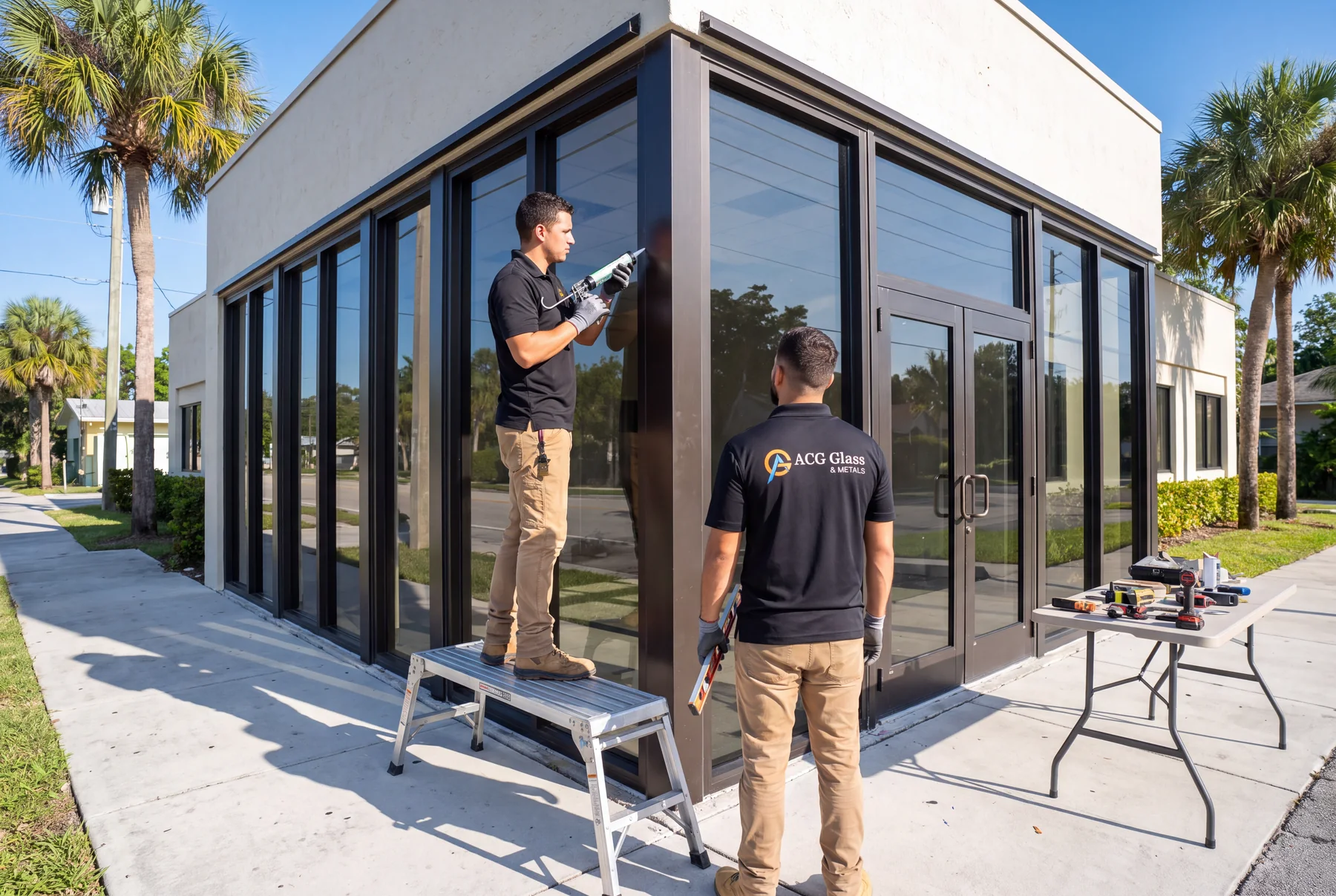
Storefront systems do not fail all at once. Closers lose their fluid, gaskets shrink, weeps block and sealant chalks, and each of those is cheap to fix and expensive to ignore. We walk the property, write down what we find with sizes, and you decide what gets done now.
8
Manufacturers bought direct
4
Counties served
1
Florida contractor license
48h
Commercial bid turnaround
Service window
Monday to Friday, 8am to 5pm
Coverage
Martin, Palm Beach, Broward and Miami-Dade
Reporting
Written condition list with sizes
License
SCC131154568
What actually fails
Five things that come back every year
In that order, roughly. The first one is most of the calls we get.
01
Door hardware
Closers lose fluid and start slamming or stop latching. Top patches and pivots wear until the door drags. Thresholds work loose under traffic. This is the most common maintenance call and the cheapest to catch early.
02
Gaskets and sealant
Wedge gasket shrinks and pulls back from the corners. Perimeter sealant chalks and cracks under South Florida sun. Both let water into a system that was designed to keep it out.
03
Blocked weeps
Storefront framing is designed to drain, not to be watertight. It sheds water through weep holes in the sill. When those pack with dirt the water backs up and finds the inside.
04
Failed insulated units
When the seal on a double glazed unit goes, moisture gets between the panes and the unit fogs permanently. It cannot be cleaned. The unit is remade and swapped, which is why finding them early matters for budget.
05
Corrosion at anchors and sills
Salt air near the coast attacks fasteners and the sill leg before it touches anything you can see. It is the failure that turns a repair into a replacement if nobody looks.
None of this is dramatic
That is the point. A door closer adjustment is a service call. The same door left dragging for a year has usually taken the pivot and the threshold with it, and now it is parts plus labor plus a door that has been annoying your tenants the whole time.
The visit
What we do while we are there
A maintenance visit is a walk of every glazed opening and every glass door on the property, with a list at the end. Nothing gets replaced without you seeing the item and the price first.
Operate every glass door and adjust the closers
Check and lubricate pivots, patches and locks
Inspect wedge gasket and structural sealant
Clear the weep holes in the sills
Check perimeter caulking for chalking and splits
Log fogged units and cracked lites with sizes
How it works
Four steps, no retainer to start
01
We walk the property
One visit, every opening and every glass door. We do not need drawings for this.
02
You get the list
Written, with sizes and photographs, split into what needs doing now and what can be scheduled.
03
You choose
Fix what you want fixed. Nothing on the list is an obligation and nothing gets ordered without a yes.
04
We set a rhythm
Most properties settle on two visits a year. Coastal buildings and heavy traffic entrances usually want more.
On site
What a maintenance visit looks like
A maintenance call is usually a short list of small things: a seal that has opened, a door that has dropped, a piece of hardware that has worn through. Catching those early is the difference between a service call and a replacement.
Parts
We buy direct, so the part matches
Replacement glass and framing come from the same manufacturers we install new, which is what keeps a repaired section looking like the rest of the elevation instead of a patch.
Our service work runs Monday to Friday, 8am to 5pm. We schedule it, we tell you the day, and we turn up on it. For a job that cannot happen while your tenants are trading, we plan the work outside those hours in advance, the way we did at Orlebar Brown in Bal Harbour Shops, where the install ran at night so the mall never closed.
What we will not do is promise you a number that answers at three in the morning. We would rather be the contractor you can plan around.
Something broke and it cannot wait?
Call the office and we will tell you honestly when we can be there. If a replacement is the answer, the sizes and the frame condition are what get you a number fastest.